
Research
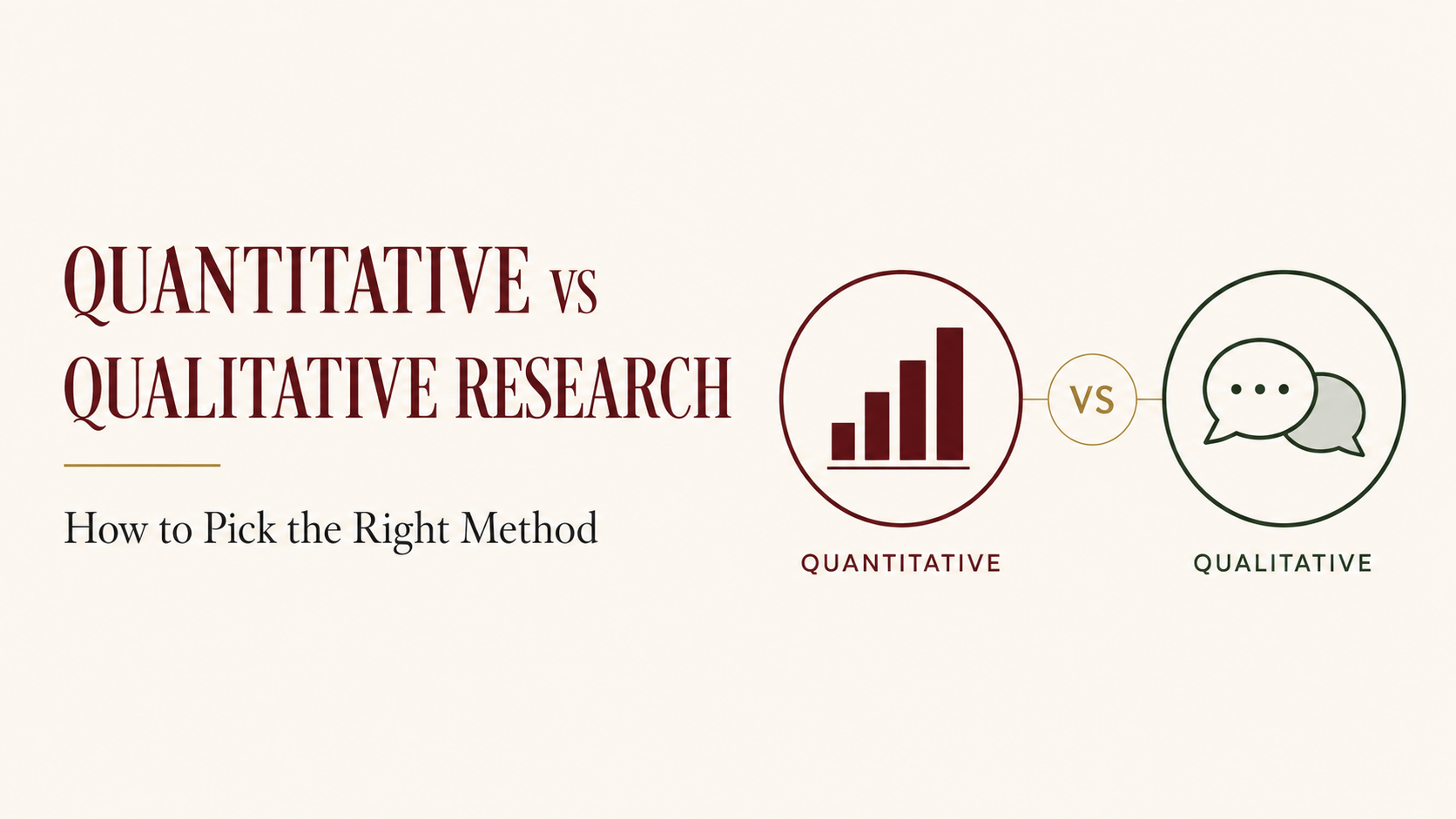
Quantitative vs Qualitative Research: How to Pick the Right Method
Choosing a research method should begin with the evidence your research question requires. This practical guide compares quantitative, qualitative, and mixed-methods research and provides a decision framework for selecting the right approach.
Dr. Abenet Yohannes, Ph.D. · 2026 · 16 min read
Introduction
Choosing the right research method is one of the most important decisions in any research project. A well-defined research problem can still produce weak results if the method used to investigate it is inappropriate.
Researchers often begin by asking: "Should I use quantitative or qualitative research?" A better question is: "What type of evidence do I need to answer my research question?"
The choice between quantitative and qualitative research should be driven by the research problem, objectives, questions, type of evidence required, and the context in which the study is conducted.
1. What Is Quantitative Research?
Quantitative research focuses primarily on measurement, numerical data, comparison, relationships, and statistical analysis. It is particularly useful when researchers want to determine how much, how many, how often, whether variables are related, or whether one factor influences another.
Quantitative studies commonly use:
- Structured questionnaires and surveys
- Experiments and quasi-experiments
- Financial and administrative records
- Structured observations
- Existing datasets and databases
- Statistical analysis
For example, an SME researcher might ask: "What is the relationship between financial literacy and the financial performance of small and medium enterprises?" This question involves measurable variables and relationships between them, making a quantitative approach appropriate.
Quantitative research is particularly useful when you want to:
- Measure the prevalence of a problem
- Compare groups or organizations
- Test hypotheses
- Examine relationships among variables
- Identify patterns and trends
- Estimate the effects of particular factors
- Generalize findings from a sample to a larger population
Its major strength is its ability to transform observations into measurable evidence that can be systematically analyzed.
2. What Is Qualitative Research?
Qualitative research focuses on experiences, perceptions, meanings, behaviors, processes, and context. Rather than asking primarily "how much?", qualitative research often investigates how and why.
Common qualitative methods include:
- In-depth interviews
- Focus-group discussions
- Key-informant interviews
- Participant observation
- Case studies
- Document analysis
- Open-ended questions
Consider this research question: "How do SME owners experience and respond to challenges in accessing business finance?" The objective is not simply to calculate how many businesses face financing constraints. The researcher wants to understand the owners' experiences, decisions, perceptions, and coping strategies. A qualitative approach is therefore more suitable.
Qualitative research is particularly useful when you want to:
- Understand people's experiences
- Explore attitudes and perceptions
- Investigate why certain behaviors occur
- Understand organizational processes
- Study complex issues within their context
- Explore a relatively new or poorly understood problem
- Generate new explanations or conceptual insights
Its major strength is the depth and contextual understanding it can provide.
3. Quantitative and Qualitative Research: The Key Differences
The distinction becomes clearer when we compare their main characteristics. Neither approach is inherently superior. The best method is the one that provides the evidence needed to answer the research question credibly.
| Quantitative research | Qualitative research |
|---|---|
| Primarily uses numerical data | Primarily uses non-numerical data |
| Focuses on measurement | Focuses on meaning and understanding |
| Often tests hypotheses | Often explores emerging ideas or explanations |
| Usually uses structured instruments | Uses more flexible data-collection instruments |
| Frequently involves larger samples | Usually works with smaller, purposefully selected samples |
| Uses statistical analysis | Uses thematic, content, narrative, or related analysis |
| Often asks ‘how much?’, ‘how many?’, or ‘what relationship exists?’ | Often asks ‘how?’ and ‘why?’ |
4. Start With the Research Problem, Not the Method
One common research mistake is deciding on a method before clearly defining the problem. Saying "I want to conduct quantitative research" starts from the method rather than the research problem.
Instead, begin by asking:
- What exactly is the problem?
- What do I need to understand about it?
- What are my research objectives?
- What questions must the study answer?
- What evidence would provide credible answers?
Once these questions are clear, the appropriate methodology becomes much easier to identify.
5. Look Carefully at Your Research Questions
The wording of research questions often provides strong clues about the appropriate approach. Questions such as the following usually point toward quantitative research:
- What proportion?
- How many?
- To what extent?
- What is the relationship?
- What factors predict?
- Is there a significant difference?
Questions such as the following generally point toward qualitative research:
- How do participants experience?
- Why does this happen?
- How do managers perceive?
- What explains this behavior?
- How does this process occur?
The method should follow the question—not the other way around.
6. Consider the Type of Data You Need
Suppose an organization wants to investigate employee turnover. A quantitative study could measure employee turnover rates, salary levels, job satisfaction scores, years of service, workload, and promotion rates. This could reveal factors statistically associated with turnover.
However, numbers alone may not explain why employees feel undervalued, how leadership practices affect morale, or why particular workplace experiences influence their decisions to leave. Interviews or focus groups could provide that deeper explanation.
Quantitative evidence can help identify patterns. Qualitative evidence can help explain the meaning and context behind those patterns.
7. Think About Generalization Versus Depth
Another important consideration is what you ultimately want to say about your findings. If your main objective is to estimate characteristics of a wider population, compare groups, or statistically test relationships, quantitative research will often be more appropriate.
If your objective is to develop a detailed understanding of a particular phenomenon, experience, organization, community, or process, qualitative research may be more useful.
This does not mean quantitative research automatically produces generalizable findings or qualitative research lacks broader relevance. Research quality still depends on appropriate sampling, research design, data quality, analysis, and interpretation.
8. When Should You Use Mixed Methods?
Some research problems cannot be adequately understood through numbers or narratives alone. In such cases, researchers can combine quantitative and qualitative approaches through mixed-methods research.
Suppose a study asks: "What factors affect the growth of SMEs, and how do entrepreneurs explain the challenges they experience?" A researcher could:
- Survey a relatively large number of SMEs to identify patterns and relationships.
- Conduct interviews with selected entrepreneurs to explore why those patterns occur.
- Integrate the two forms of evidence to develop a more comprehensive interpretation.
Mixed methods can be powerful when one form of evidence complements or helps explain another. However, researchers should not use mixed methods simply because combining two approaches appears more sophisticated. It requires additional time, skills, resources, methodological justification, and careful integration of findings.
9. Avoid These Common Mistakes
Choosing a method because it seems easier
A researcher's familiarity with questionnaires or interviews should not determine the methodology. The research question should.
Assuming quantitative research is always more scientific
Numbers do not automatically guarantee rigorous research. Poor sampling, weak measurement, inappropriate statistical analysis, or unreliable data can produce misleading conclusions.
Treating qualitative research as informal conversation
Good qualitative research requires systematic sampling, carefully designed questions, rigorous data collection, transparent analysis, and credible interpretation.
Using mixed methods without integration
A study does not become genuinely mixed-methods simply because it includes a questionnaire and a few interviews. The different forms of evidence should have a clear purpose and be meaningfully integrated.
Confusing the research method with the data-collection instrument
A questionnaire, for example, is an instrument rather than a complete research methodology. A sound study requires alignment among the research problem, objectives, design, sampling, instruments, analysis, and interpretation.
10. A Practical Decision Framework
Before selecting your method, ask yourself: What am I trying to discover? If you need measurement, comparison, prediction, or statistical relationships, consider quantitative research. If you need understanding, explanation, experience, meaning, or context, consider qualitative research. If you genuinely need both forms of evidence, consider mixed methods.
Then ask:
- What are my research questions?
- What data are needed to answer them?
- Who or what can provide those data?
- How will the data be collected?
- How will the data be analyzed?
- What conclusions do I expect the evidence to support?
- Do I have sufficient time, resources, access, and analytical skills?
These questions help ensure that methodological choices are based on research logic rather than personal preference.
Conclusion
The choice between quantitative and qualitative research is not a competition between two approaches. It is a question of fit.
Quantitative research is powerful when researchers need measurement, statistical comparison, hypothesis testing, or analysis of relationships. Qualitative research is powerful when researchers need to understand experiences, processes, perceptions, meanings, and context. Mixed methods can be valuable when the research problem genuinely requires both.
Ultimately, strong research begins with a clear problem and well-formulated research questions. Once those are established, the methodology should follow logically.
Do not choose the method first and force the research problem to fit it. Define the problem first, determine what evidence you need, and then select the method capable of producing that evidence.
Need Support with Strategic Planning?
Dr. Abenet Yohannes provides strategic planning, organizational assessment, financial management, risk and compliance, research, project advisory, and capacity-development services — including planning facilitation, situational analysis, strategic objectives, performance indicators, implementation plans, budgets, risk registers, and monitoring dashboards.
Turn your strategy into measurable results
A short consultation can clarify priorities, indicators, and the accountability structure your plan needs.